Detained Ukrainian journalists are free again – Mykhailo Tkach reports on the arrest
Mykhailo Tkach speaks in an interview with editor-in-chief Sevğil Musaieva from "Ukrainska Pravda" about his arrest and release in Vienna
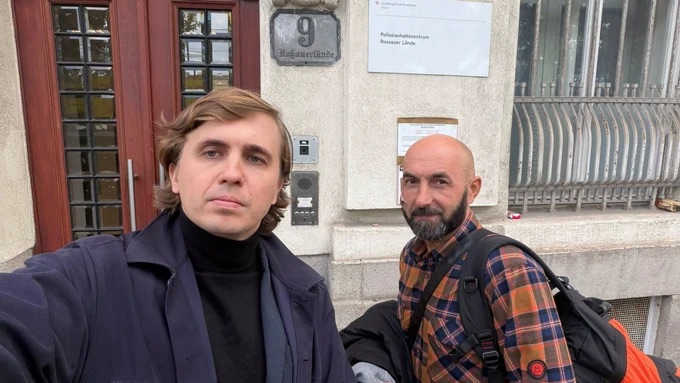
In an online interview with Sevğil Musaieva, editor-in-chief of „Ukrainska Pravda,“ Mykhailo Tkach, head of its investigative department, described the arrest of himself and his colleague Yaroslav Bondarenko on October 8, 2026 at around 4 p.m. local time in Vienna.
Tkach was released after one night in police custody on October 9 at around four in the morning. According to Tkach's account, Yaroslav Bondarenko remained in police custody at the time of the interview and was released in the afternoon of October 9, 2026.
The Yanus editorial team publishes below a summary based exclusively on the transcript of the online available interview.
The account of the police operation and interrogations comes exclusively from Mykhailo Tkach. The presumption of innocence applies to all persons mentioned.
Starting point: journalistic research in Vienna
According to their own account, Tkach and Bondarenko had been in Vienna for several days to research the whereabouts of Ruslan Kravchenko, the former Ukrainian prosecutor general. The editorial team considers this research to be a matter of public interest.
Both journalists emphasize in the conversation that their filming took place exclusively in public places. The moderator explicitly stated that they had not entered any private property. Tkach pointed to earlier research conducted by his team in Vienna and to publicly accessible posts, based on which their journalistic work could be traced.
The arrest on the street
According to Tkach's account, the arrest took place on October 8, 2026 at around 4 p.m. The two journalists were driving from one filming location to the next and stopped at a traffic light, approximately five kilometers from the city center.
Suddenly, approximately five to seven armed, masked individuals approached the vehicle. They had smashed the windows, pointed weapons at the occupants, and shouted commands in German. Tkach reports that he immediately raised his hands and stated that they were journalists.
Subsequently, both were pulled from the car and thrown face-down onto the street. They were searched in this position and the officers initially restrained their hands with a band or a zip tie. Tkach also says that one person pressed a knee against his neck and ordered him to be silent.
After that, he was brought into a nearby passageway and pressed face-first against a wall. He describes the operation as extremely intimidating and says he felt he was being treated as if he were a terrorism suspect being arrested.
Why Tkach initially thought of kidnapping
Tkach explains that in the first 30 to 40 minutes he did not understand who the armed persons were. He had neither seen service IDs nor recognizable police markings. The persons were dressed differently and in civilian clothes; there was no explanation he could understand. .
For this reason, he initially feared that someone might have ordered a kidnapping. Only when he saw police vehicles did it become clear to him that it was a police operation. This reassured him somewhat because he now at least hoped for a lawful procedure.
However, he did not receive a substantive explanation for his arrest until much later.
Bondarenko's injuries and the separation of the two
Tkach reports that when the car windows were smashed, glass splinters flew into Bondarenko's face. He had seen this himself immediately before her arrest.
In the course of events, he learned that Bondarenko had been taken to the hospital and injuries to her face had to be stitched. However, Tkach cannot confirm this information in the conversation through a later meeting of his own: since the operation, he has not seen his colleague again.
According to his knowledge at the time, Bondarenko was subsequently brought back to the police station and questioned further. How serious his injuries were and when he would be released remained unclear at the time of the interview.
At the beginning, the moderator still assumes that Bondarenko is also already free. Tkach explicitly corrects this assumption, since his release occurred only later.
Transport and accommodation at the police station
Tkach describes that he was placed in a very narrow single compartment of a police transport vehicle. The journey with sirens lasted approximately 20 minutes.
At the police station, all his personal belongings were taken from him, including his phone. He also had to remove his shoes. Subsequently, he spent about two hours in a single cell without being told why he was being detained.
He repeatedly asked passing police officers for the reasons, but received no explanation. A doctor visited him during this time and asked how he was feeling.
Tkach describes how, given the severity of the operation, he searched for possible explanations. At one point, he even feared that someone could have planted something in their car. He presents this as a thought he had at the time, not as an established fact.
Later he was taken to another room and had to undress completely. After that, he received his clothing back, his weight and height were recorded. He did not want to sign a German-language document because he did not understand its contents. According to his account, an officer reacted angrily to this.
Beginning of interrogation and contact with the editorial office
According to Tkach's account, comprehensible communication only began around 11 p.m., when he was taken to two investigators. An interpreter made understanding possible and worked until morning.
He was then told that he could call a close person. Through this call, he was able to pass on information about his arrest. The editorial staff subsequently reported on the events online and organized legal support.
The investigators also informed him that he could refuse to make a statement. Tkach declared himself ready to make a statement because he had nothing to hide.
The allegations described by Tkach
At the beginning of the interrogation, he received a document that he understood as a kind of notification of the suspicions against him. He names three allegations:
- Espionage in the interest of the Ukrainian military intelligence service;
- Membership in a criminal organization;
- Damage to Austria, whereby he reproduces the exact wording of this third allegation only from his recollection.
The transcript contains neither the wording of the document nor specific Austrian legal provisions.
Tkach describes these allegations as absurd given his journalistic work. According to his account, no concrete evidence of illegal activity was presented to him during the interrogation. He gained the impression that the authorities were responding to information that someone had passed on to them and that may have been misleading.
The questions about his Ukrainian military accreditation
A key subject of the interrogation was Tkach's journalistic accreditation with the Ukrainian armed forces. He explains that such accreditation enables journalists to report under the conditions of war and is also issued to foreign journalists.
In his view, however, the investigators saw in this a possible indication of his affiliation with Ukrainian military structures. His documents were scrutinized very closely for connections to the armed forces or intelligence services.
Tkach emphasizes that he explained his work to the investigators and suggested to them to view his published research on Google and YouTube.
Support from Ukrainian diplomats
Tkach and the moderator expressly thank the Ukrainian Foreign Ministry, Foreign Minister Andrij Sybiha, Ambassador Vasyl Khymynets, the Consul, and Ministry spokesman Heorhij Tychyj.
The consul came to the police station around one o'clock in the morning. He made efforts to obtain access to both journalists and informed the editorial office about the developments.
After the first, approximately two-hour part of his interrogation, Tkach was able to speak with the consul and describe the course of events to him. Subsequently, the interrogation was continued. He describes the diplomatic support as particularly important.
Release and continuing open investigations
After the interrogation, Tkach was brought back into a cell, in which there was only a bench. He was exhausted and had already fallen asleep while sitting.
At around four o'clock in the morning, he was informed that the responsible prosecutor had ordered his release. Tkach understands this decision to mean that apparently there was no sufficient basis for further detention.
He also expresses the impression that the original arrest took place without prior court authorization. This is not confirmed in the conversation by documents.
His release does not mean, according to the interview, a confirmed dismissal of the proceedings. Tkach assumes that investigations will continue and the prosecutor's office must decide on further steps. He explicitly commends the fact that the responsible persons worked even at night and did not postpone the decision until the next working day.
Tkach's suspicion about what triggered the police operation
Tkach suspects that a person his team was researching may have influenced Austrian authorities with false or manipulative information. From his perspective, one particularly conceivable claim is an assertion about connections between the journalists and Ukrainian military or intelligence services.
When asked whom he specifically suspects, he names Ruslan Kravchenko or persons from his circle. He justifies this by saying that their current research was focused on Kravchenko's whereabouts.
In the interview, however, Tkach provides no evidence that Kravchenko or his circle actually filed a report or triggered the operation. This connection remains his hypothesis.
He points to earlier attempts to obstruct his team's work, including during research on Timur Mindich in Israel. There too, people allegedly tried to portray the journalists' activities as unlawful.
Further criticism of a possible instrumentalization of Austrian authorities
Tkach sees in the incident the danger that persons who wish to evade journalistic investigations could use state security authorities for their own interests.
His argument is: if journalistic research is portrayed as espionage or a security threat, authorities can respond with extensive measures. This hinders the research, even if the suspicion is not substantiated later.
He emphasizes that his team has already spent a second day dealing with the consequences of the arrest instead of continuing their editorial mission. At the same time, he acknowledges that Austrian authorities must take security information seriously. His criticism is directed primarily against what he sees as possible deception of the authorities and against the harshness of the operation.
Furthermore, he points to the public costs: numerous emergency personnel and vehicles, a road closure, as well as nighttime work by investigators and prosecutors were required for this incident.
The research into Kravchenko's stay and possible asylum proceedings
In the final section, Tkach and the moderation explain the underlying research in more detail. The editorial staff published documents from the Austrian central registration register, according to which Kravchenko and his wife are registered in Vienna.
The moderator spoke in this interview about how both had initiated a procedure to obtain political asylum. Tkach formulates it more cautiously: the registration could suggest that they pursued a corresponding legal path.
Furthermore, the editorial staff found that the address given was that of a company that provides mailbox and address services. According to legal advice obtained by the editorial staff, the actual place of residence should have been provided there.
The conversation partners therefore raise the question of whether the registration is in order and why the Austrian authorities have not responded to the publication so far. An official determination regarding a legal violation is not mentioned in the transcript.
Why the editorial staff of „Ukrainska Pravda“ also sees an Austrian public interest
Tkach argues that the Austrian population also has an interest in knowing which former Ukrainian officials are in the country and for what reasons.
He points to the Operation „Carthago“ mentioned in the conversation and possible investigations into fraudulent call centers. Should it be possible to demonstrate that Ukrainian top officials protected such structures, Austrian citizens could also be among the victims.
He explicitly formulates this statement as a possible future investigation result. The interview provides no evidence of corresponding involvement by Kravchenko.
Politically, Tkach also criticizes the possibility that persons suspected of corruption in Ukraine could seek protection in Europe, while Ukraine simultaneously needs European financial aid.
What clarification Tkach and the editorial team demand
The editorial board of „Ukrainska Pravda“ announced that it would continue working with lawyers, follow up on Bondarenko's situation, and demand a public statement from the Austrian authorities. Journalistic and human rights organizations are urged to support their colleagues.
Tkach particularly calls for clarification of the following questions:
- What specific information led to the arrest?
- Who provided this information, and was it accurate?
- What was the basis that justified the deployment of armed, masked forces and the smashing of car windows?
- Why were the journalists held for so long?
- What further steps are planned in the proceedings?
In conclusion, he suggested that the Austrian police should release video footage of the operation. This would make it possible to compare the course of the operation with the actual suspicions.
At the time of the conversation, the reasons for and the official assessment of the operation thus remained unclear. Tkach was already free and was waiting outside the police station for information about Bondarenko; an Austrian statement and a confirmed decision on the conclusion of the investigation were not yet available to the editorial team of „Ukrainska Pravda“.
Source
Interview in „Ukrainska Pravda“ with Mykhailo Tkach
Photo: (c) Mikhail Tkach