
Personal Experiment: A Year of Everyday Life with an AI Robot in Vienna
A U.S. researcher living in Vienna bought a Chinese-made humanoid robot for about 60,000 euros. Through her own experiment, she demonstrates that living alongside these intelligent machines is still difficult.
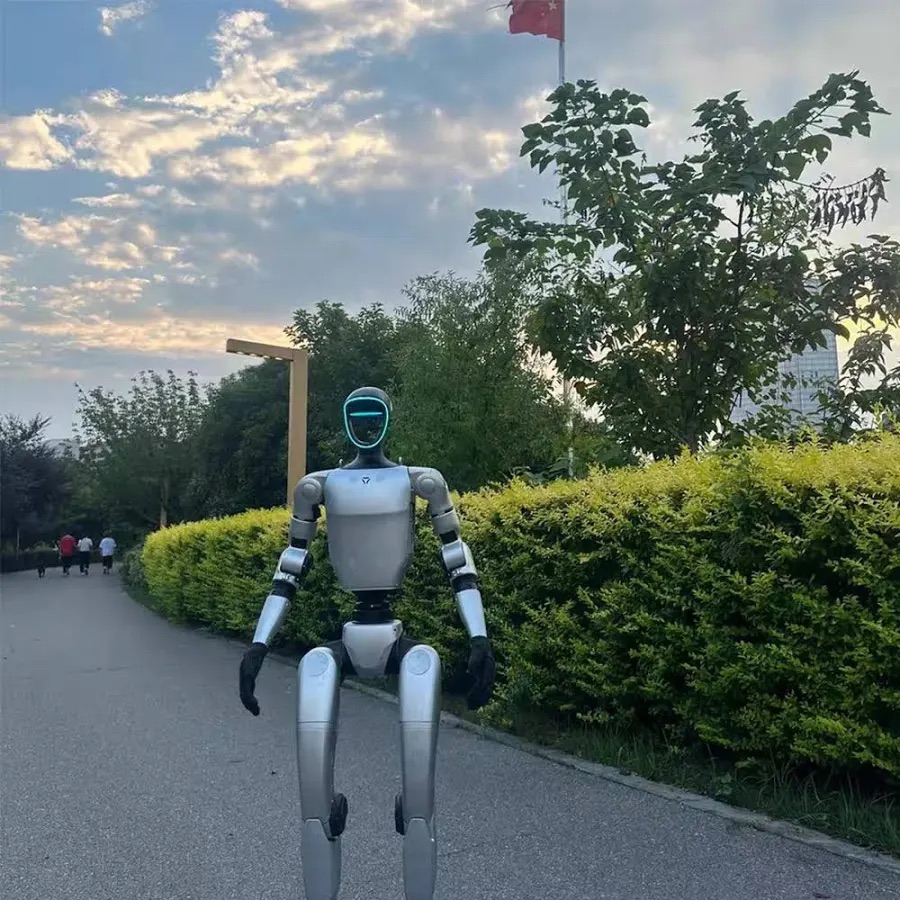
In April 2025, Emily Genatowski, a 35-year-old American and doctoral student in Digital Humanities at the University of Vienna, picked up a package from a shipping company in Vienna. Inside: a Unitree G1 EDU 2 humanoid robot, manufactured in China, 1.30 meters tall, weighing 35 kilograms, with a purchase price of around 60,000 euros. Genatowski has now been living with the robot—which she calls Tova, the Hebrew word for „good“—for over a year. Her goal is not to create a marketing video, but rather to conduct a sober assessment: What can an AI robot actually accomplish in real-life everyday situations, and where does it reach its limits?.
A robot without a face, a lab without hands-on experience
The Unitree G1 EDU 2 has no mouth and no eyes in the human sense; instead, it has LED strips and a camera in place of a face. It features a laser system for mapping its surroundings, a depth camera, and an integrated large language model that enables it to process language. It is considered „humanoid“ because of its shape, not because of its behavior: When asked—even in Mandarin—the manufacturer itself was unable to provide Genatowski with any information about how the device behaves toward pets, for example.
Door handles as the biggest hurdle
Genatowski’s daily life with Tova—along with their dog Marceau in an apartment in Vienna’s 9th district—consisted of a long list of unresolved problems: legal ambiguities, technical limitations, and practical failures. This was particularly evident in the robot’s hands. Three-finger or five-finger designs with multiple joints sound sophisticated, but in practice they failed when encountering ordinary doorknobs, drinking vessels, or faucets. Genatowski quickly had to abandon plans to use Tova in a choreographed manner. Instead, she took the robot to the registration office and on the streetcar to document how society and its institutions react to such a device in public spaces.
From the Lab to Real Life
Most people are familiar with humanoid robots from short clips on social media: doing cartwheels, boxing, ironing, stocking shelves. Genatowski deliberately distances herself from this portrayal. Her research project aims to highlight precisely those obstacles—both technical and societal—that cause a robot like Tova to fail in reality.
The Chinese manufacturer Unitree is one of the best-known international providers of affordable humanoid robot platforms for research and development; the EDU model is specifically designed for universities and research institutions, not for private households.
For Europe, this case illustrates two developments at once: China is pushing ahead with the mass production of humanoid robots at a remarkable pace. Manufacturers such as Unitree, UBTech, and Fourier Intelligence are bringing systems to market at prices that would have been unthinkable just a few years ago.
At the same time, Genatowski’s experience shows that there is still a wide gap between promotional videos and real-world applicability. For Austria and the EU, this means that those considering regulations for AI robotics in public spaces still have time—but that time is running out. After a year with Tova, Genatowski’s conclusion is sobering: The future has already arrived in the storage room, but it will take much longer to make its way into the living room.
You can find the full article in the Austrian news magazine „profil“:
https://www.profil.at/gesellschaft/abenteuer-alltag-emily-und-ihr-ki-roboter/403180605