EU and Philippines agree on the fundamentals of a free trade agreement
After a telephone call between Ursula von der Leyen and Ferdinand Marcos Jr., a political framework is in place, but the detailed work of the negotiators is not yet complete.
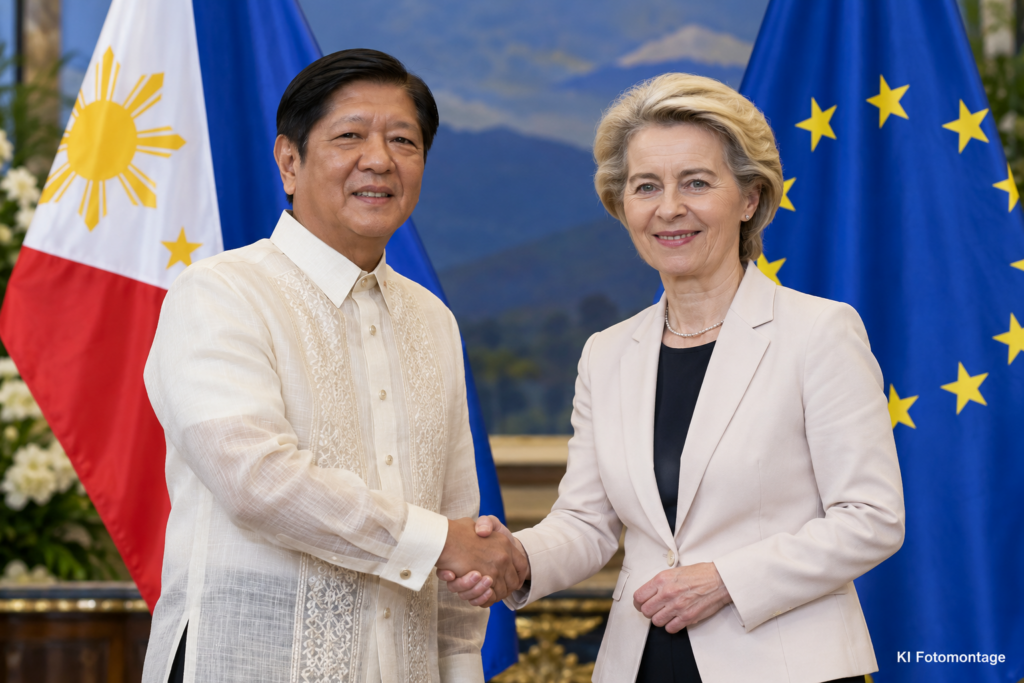
The European Union and the Philippines have announced achieving a „substantial agreement“ on a free trade agreement.
EU Commission President Ursula von der Leyen announced the agreement following a phone call with Philippine President Ferdinand Marcos Jr. The negotiating teams of both sides must now work out remaining technical and legal details before the text can be formally concluded.
What the agreement is about
The planned trade agreement is intended to reduce or eliminate tariffs on a broad spectrum of goods and facilitate market access for businesses on both sides. Negotiations cover, among other things, provisions on rules of origin, technical trade barriers, public procurement, and investment provisions.
The Philippines count among the fastest-growing economies in Southeast Asia and are an important production site for electronics, textiles, and agricultural products.
The EU has been negotiating such an agreement with Manila for several years. The recent agreement marks a political breakthrough, but the formal conclusion of the treaty text as well as subsequent ratification by the European Parliament and the member states are still pending. Only after that would the agreement actually come into force.
The timeframe and steps for implementation
After the political agreement, there is usually a phase of legal review in which the contract text is translated into all EU languages and legally secured. Subsequently, the EU Commission must submit the agreement to the EU Council and the European Parliament for approval.
In the case of mixed agreements that affect both EU competencies and national competencies, ratification by the individual member states is additionally necessary.
This process can take several years depending on the agreement. The EU-Vietnam Free Trade Agreement, which was signed in 2019 and only came into force in August 2020, serves as a comparison. How long the process will take for the Philippines is currently open.
Trade volume and economic context
The EU is one of the most important trading partners of the Philippines. The bilateral trade in goods most recently included goods worth several billion euros annually, with Philippine exports mainly in the areas of electronics, semiconductors and agricultural products such as coconut oil. The EU exports, in turn, machinery, vehicles and chemical products, among other things, to the Southeast Asian island nation.
The agreement would be the latest in a series of EU trade agreements with Southeast Asian states, following already existing agreements with Singapore and Vietnam. The EU Commission is furthermore negotiating similar arrangements with other states in the region, such as Indonesia and Thailand.
For Austrian companies, an agreement with the Philippines could facilitate market access in a country with around 115 million inhabitants. The Austrian Economic Chamber has so far listed the Philippines as a comparatively small but growing trading partner, with Austrian firms' export interests in areas such as mechanical engineering, pharmaceuticals and food processing.
Specific tariffs and market access conditions that would directly affect Austrian exporters are only available with the final contract text, whose conclusion and ratification are still pending.
Source: POLITICO | Original Article