
„We paid bribes“: Jegor Burkin describes an alleged protection‑money system for Ukrainian call centers
The „Mexican“ and the protection‑money system: New statements in the „Carthage“ case Jegor Burkin confirms in a detailed interview that he paid bribes, and describes an alleged protection‑money system for Ukrainian call centers: $21,000 per month per 50 employees. He names intermediaries, talks about possible connections to high‑ranking officials, and raises serious corruption accusations. Yanus Insider analyzes Burkin's statements and the open questions behind the NABU operation „Carthage“.
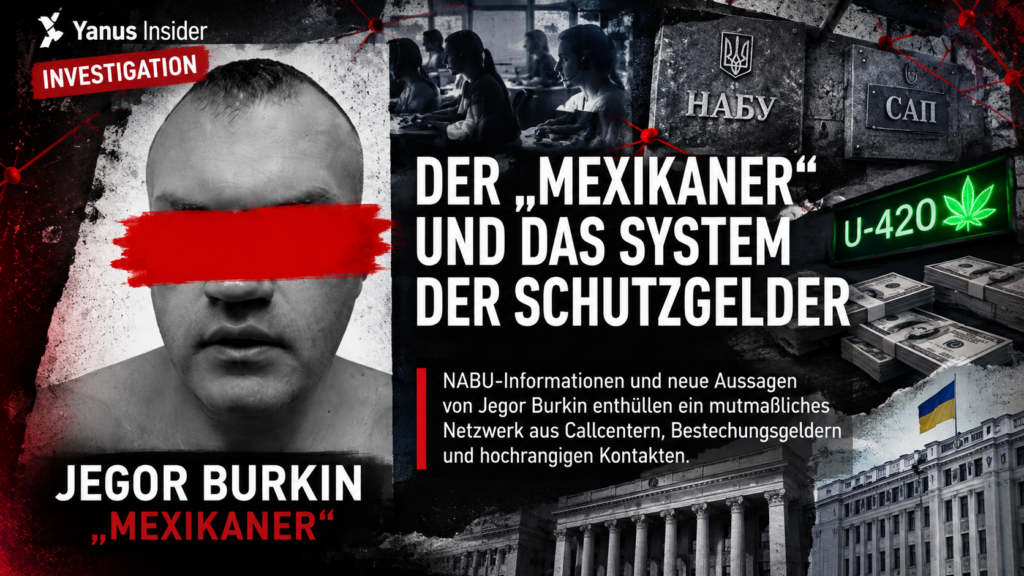
Yanus Insider | Investigative Research
A key player in the context of the NABU operation „Carthage“ confirms his voice on released audio recordings, describes regular payments to representatives of Ukrainian law‑enforcement agencies and names alleged intermediaries. But how far did this system extend – and what can actually be proven?
An admission that changes the story
„That we paid bribes for it, I confirm. Also, that U-420 paid bribes.“
It is one of the most remarkable statements from a detailed interview that Jegor Burkin, known by the nickname „Mexican“, gave to the Ukrainian interviewer Wassyl Tymoschenko.
Burkin is among the key individuals mentioned in connection with the „Carthage“ operation of Ukraine's National Anti-Corruption Bureau (NABU). The case involves allegedly fraudulent call centres, corruption ties and the retail network U-420.
In the roughly two‑and‑a‑half hour conversation Burkin does not deny that his voice can be heard on the recordings released by NABU.
„I do not want to deny anything. On the contrary, I want to confirm that everything was exactly as it was,“ he explains.
He then claims that the released recordings show only a fraction of the actual events:
„Everything you have heard may be at most five percent of what is currently happening in Ukraine.“
This is not a comprehensive admission of guilt. On the contrary: Burkin uses a substantial part of the interview to repudiate particularly serious accusations against himself.
His statements about bribe payments and contacts with law‑enforcement agencies, however, raise a separate question: Did an organized system exist in Ukraine in which call centres were protected from state investigations in exchange for regular payments – and who benefited from it?
21,000 dollars for 50 employees
The most concrete part of the interview concerns the alleged rates for the protection of call centers.
According to Burkin's account, 21,000 US dollars were paid monthly for every 50 employees.
The sum was divided as follows:
- 7,000 US dollars for the Ukrainian security service SBU.
- 7,000 US dollars for the National Police.
- 7,000 US dollars for the General Prosecutor's Office.
Burkin therefore describes this not as a one-time payment to initiate a specific procedure, but as a regular contribution intended to ensure as smooth an operation as possible.
According to this model, a call center with 100 employees would have had to pay $42,000 per month, and one with 150 employees $63,000 per month.
Burkin estimates that about 1,500 call centers have been operating in Ukraine. Furthermore, he speaks of a monthly industry revenue in the billions.
These figures have not yet been independently verified. They initially reflect only Burkin's own assessment.
Who collected the money?
In the lengthy interview, Burkin mentions, in particular, Andrij Ossipow as well as the now‑suspended intelligence general Serhii Duka and Oleksandr Kowaltschuk, who also held a leadership position in the domestic intelligence service SBU.

According to his account, he was initially in direct contact with Duka and Kowaltschuk. Later, Ossipow joined as an intermediary to reduce direct communication.
Ossipow regularly collected the payments, usually at the beginning of the month.
Furthermore, Burkin and Kowaltschuk report that a Mercedes V-Class was given as a birthday present.
A particularly serious claim is another allegation: In connection with a conflict with a competing call‑center group, about 15 to 15.5 million dollars are said to have been transferred to Ukraine's State Investigation Bureau (DBR) via Kowaltschuk.
Whether these payments actually took place, who received them, and how the money was further distributed cannot be determined from the interview alone.
The alleged role of Oleh Tatarow
Burkin claims that such a protection‑money scheme could not have worked without the involvement of higher levels of the Ukrainian law‑enforcement authorities.
In this context he repeatedly mentions the deputy head of the Ukrainian presidential administration, Oleg Tatarow, whom he links to the alleged coordination of various security and law‑enforcement structures.
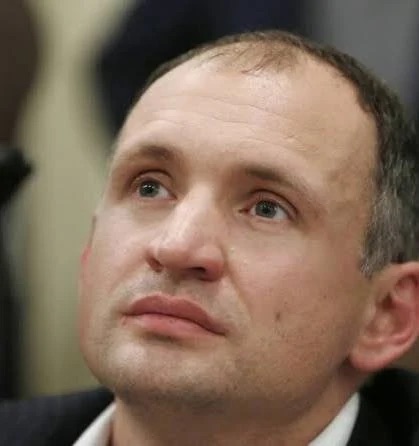
His argument: If a businessman, for example, pays only one police unit, other authorities could still conduct house searches, seize computers, or launch criminal investigations.
A functioning protection agreement must therefore involve several institutions simultaneously.
According to Burkin's account, payments were forwarded within the respective government hierarchies.
However, the crucial question remains unanswered: Did Tatarow personally receive payments, issue corresponding instructions, or actually control the alleged structure?
For this, Burkin presents no independently verifiable proof of payment in the interview.
His accusations should therefore be treated as the claims of a participant, not as established facts.
Call center: legitimate business or fraud industry?
Burkin states that he entered the call‑center business in 2021.
After the start of the Russian full‑scale invasion in February 2022, the activities were initially halted and resumed in the summer of the same year.
He distinguishes several business models: alleged financial investments, fraudulent bank calls, dietary supplements, esoteric services and other forms of telephone sales.
In doing so, Burkin insists that his own call centers mainly focused on dietary supplements and fortune‑telling.
He describes some of these activities as possibly immoral, but not illegal.
This distinction is of central importance to his defence.
That an entrepreneur pays bribes is, of course, disreputable. However, it does not automatically prove that all of his business activities were fraudulent.
Conversely, his own portrayal is insufficient to demonstrate the legality of the call centers.
U-420: A business model on the edge of the law
Another focus of the interview is the retail network U-420.
Burkin confirms its involvement in setting up the company and states that the network temporarily comprised around 110 sales outlets.
Among the items sold were herbal blends containing synthetic cannabinoids.
Burkin claims that the substances used at the time of sale were not prohibited. The formulations were adjusted to legal changes.
He also confirms that documents supporting marijuana legalization were prepared and passed on to political decision‑makers.
The economic goal was to have a network of 200 to 300 stores ready in case of a possible legalization.
According to his vision, U‑420 would thus have a significant head start over potential competitors.
The statements show a clear economic strategy. However, they do not by themselves prove the legality of all sold products nor any unlawful influence on legislation.
Threats against investigative journalist Denis Bihus
The published discussions about possible violence against investigative journalist Denis Bihus are especially explosive.
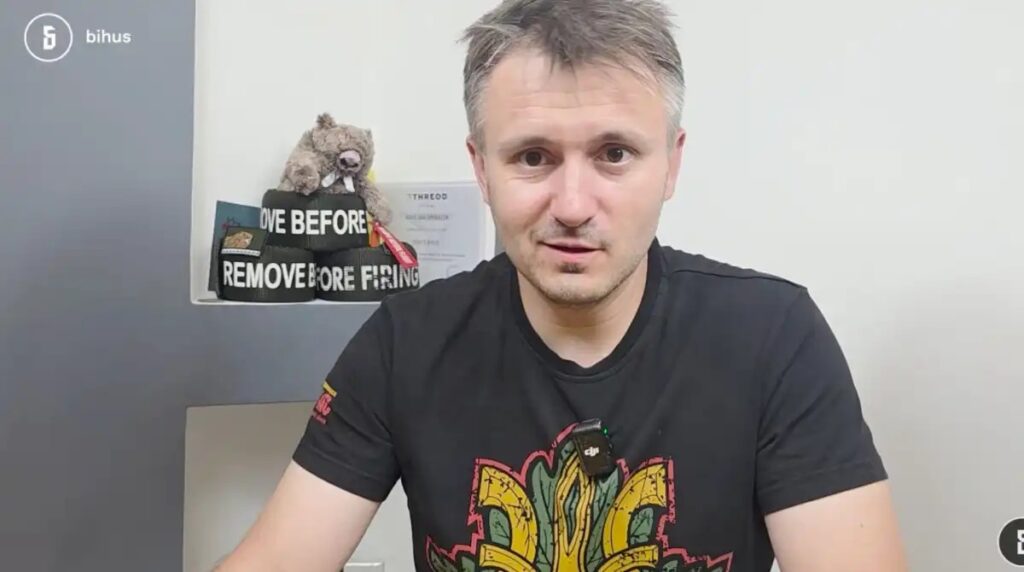
The recordings discuss, among other things, an acid attack and an attack with hammers.
Burkin confirms that such discussions took place. However, he denies that an attack was actually being prepared or carried out.
According to his account, he wanted to intimidate his conversation partners and convey that he was capable of extreme measures.
He describes this as a kind of psychological game. This explanation leaves the question of the seriousness of the threats open.
The conflict with Mykola Tyschtschenko
Towards the end of the interview, Burkin describes his relationships with Ukrainian politician Mykola Tyschtschenko.
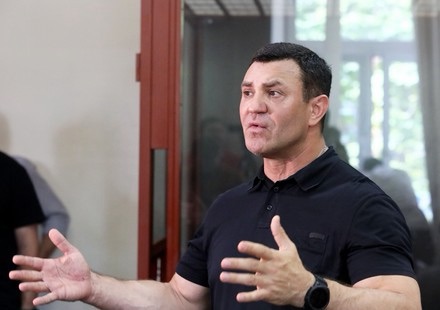
According to his account, Tyschtschenko initially helped with matters related to call centers.
Later, however, he demanded a share of the revenues.
Burkin claims that this financial conflict led to a rift between them.
He also reports having funded individual charity events abroad linked to Tyschtschenko.
He cites various amounts, but admits he does not recall all the details precisely.
Burkin also confirms that he himself has published recordings of conversations with Tyschtschenko.
Cryptocurrencies, Everstake and the issue of military donations
Another part of the interview leads into the world of cryptocurrencies and Ukrainian weapons procurement.
The interviewer mentions possible connections between people from Burkin's circle, the blockchain company Everstake, and the Ukrainian politician Mychajlo Fedorow.
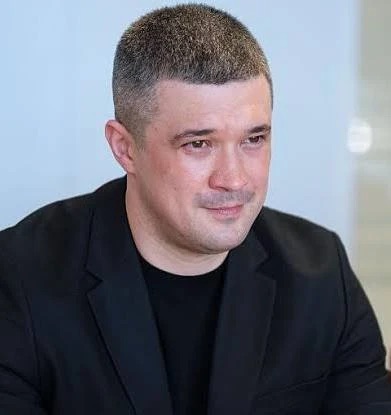
Alleged investigations into cryptocurrency transfers and military procurements are discussed. Amounts of roughly 12.2 million and 42 million US dollars are mentioned in the conversation.
What matters, however, is who makes which claim.
The specific allegations about possible irregularities in donations and drone procurements are mainly presented by the interviewer.
Burkin does not confirm having been personally involved in the questionable transactions or having personally verified the alleged money flows. When asked about the possible role of Fedorow, he responds partially explicitly speculatively.
Thus the interview does not provide evidence that Fedorow was involved in embezzlement or that Everstake illegally forwarded donation funds.
However, it does identify starting points for independent research: blockchain transactions, wallet addresses, contracts, actual deliveries, and the economic relationships between the companies involved.
These questions deserve a separate investigation and should not be equated with the alleged protection money system of the call centers without additional evidence.
Contacts with Russian intelligence services
Burkin confirms in the interview that he had contacts with Russian representatives through an acquaintance named Roman Rudyk.
According to his account, the starting point was conversations about cryptocurrencies.
Later, the Russian interlocutors tried to persuade him to cooperate.
Burkin claims he rejected such cooperation as soon as it became clear that it could be directed against Ukraine.
His statements therefore confirm contact, but not activity for Russian intelligence services. The actual nature of these relationships remains open without further documents and witness testimony.
What role did the Ukrainian military intelligence service GUR play?
Burkin distinguishes in his statements between traditional law enforcement agencies and intelligence services.
While, according to his account, the SBU, National Police, Prosecutor's Office and DBR were relevant for the alleged protection money agreements, he does not consider the military intelligence service GUR to be part of this system.
He bases this on the different responsibilities of the institutions. The interview therefore provides no concrete evidence of GUR's involvement in the payments described by Burkin.
A laptop with allegedly incriminating material
Burkin repeatedly states that he is ready to cooperate with the National Anti-Corruption Bureau NABU, the Specialized Anti-Corruption Prosecutor's Office SAPO and American investigative authorities.
He claims to have recordings, screenshots, cryptocurrency addresses and information on money transfers.
He also mentions a laptop whose contents, according to his account, could incriminate numerous other people.
Whether these documents exist, whether they are authentic, and whether they actually support his accusations remains unclear.
The announced evidence could become relevant for further investigations. However, until they are examined, they remain a promise.
Why is Burkin speaking right now?
What stands out is the way Burkin describes his own role.
On one hand, he confirms bribery payments, economic relationships with intermediaries, and the attempt to safeguard his business interests through contacts with influential persons.
On the other hand, he presents himself as a victim of a corrupt system that forced entrepreneurs to pay and used criminal proceedings as a pressure tactic.
These two portrayals do not necessarily exclude each other.
An entrepreneur can simultaneously profit from corrupt relationships and be blackmailed through the same structures.
However, Burkin's current willingness to talk about the system does not erase his earlier responsibility.
His public statements could serve several purposes: exposing actual misconduct, settling scores with former business partners, or improving his position with investigative authorities.
Which motives are predominant cannot be determined from the interview alone.
What is proven – and what is not?
The interview contains three distinct categories of information.
First: personal admissions. Burkin confirms his voice on released recordings, describes bribery payments, and discusses his own business activities.
Second: Allegations against third parties. He names alleged recipients and intermediaries of payments, describes the possible involvement of senior officials and raises accusations against former political contacts.
Third: The interviewer's speculations and questions. This includes, in particular, parts of the discussion about cryptocurrency donations, Everstake, Fedorow and military procurements.
These categories must not be mixed journalistically.
A personal admission can be an important starting point for investigations. However, it does not automatically prove the guilt of all the individuals the speaker later names.
The real scandal behind „Karthago“
Jegor Burkin's statements raise a question that goes far beyond the activities of a single entrepreneur.
What happens when state powers for law enforcement become a tradable service?
If companies regularly pay so that no searches take place, no computers are seized, and investigations do not occur, the line between state control and private business interest would be fundamentally damaged.
Law enforcement agencies would then not only monitor compliance with the law, but might also decide who is spared from enforcement in exchange for payment.
Burkin claims to know such a system from the inside.
His statements contain specific names, amounts and procedures. Yet the decisive evidence is still missing: Which payments can actually be traced, who received the money, and which state decisions were made in return?
Operation „Karthago“ may therefore be more than a case against allegedly illegal call centers.
It could become a fundamental investigation of the relationships between economic networks, law enforcement agencies and political decision‑makers.
Whether this dimension can be proven will not be decided by further interviews, but by verifiable documents, financial transactions and independent investigations.
The central question is no longer only who operated the call centers, but also who enabled their activity, who profited from it, and how far the alleged protection structures actually extended.
Editorial note:
This article is based on the interview of Jegor Burkin with Wassyl Tymoschenko. Burkin's statements and the accusations presented by the interviewer are reproduced as such. They do not constitute judicial findings.
All named persons are presumed innocent.