
Toyota Robotics: 400,000 machines for a robot army
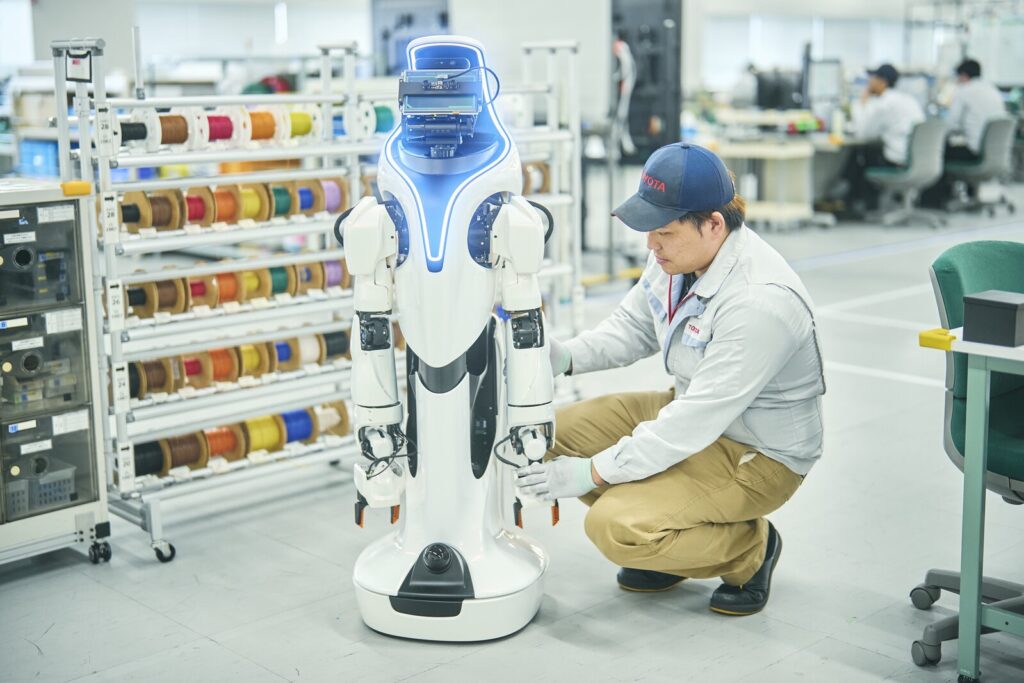
The plans range from factory robots to humanoid systems, and Toyota wants to sell them to other manufacturers soon. Photo: Robot ELEY (Toyota)
The Japanese car group Toyota Motor has established its own robotics division: Toyota Robotics will develop, commission, and commercially market robots, including humanoid systems. The new structure will be led from January 1, 2027 by Takefumi Shiga, the company's executive vice president for production.
Previously scattered robotics projects will now be placed under direct management leadership, with the aim of building robotics as an independent business field.
Demand in the billions
The scale of the plans is considerable. Toyota estimates that automating its factories from 2028 will require about one trillion yen per year, roughly 5.6 billion euros. According to an investor presentation, the group could need around 400,000 robots between 2028 and 2040: 150,000 for Toyota and its group companies, and 250,000 for suppliers.
This includes both industrial manipulators and humanoid systems. The figures mentioned are a demand estimate, not approved annual expenditures.
From the Lab to the Factory
Some developments have already moved beyond the laboratory stage. Toyota is testing the robot ELEY, a wheel‑based platform with two gripping arms, which trains employees directly on the production line by demonstrating precise movements.
In addition, the Toyota Research Institute is working with Boston Dynamics on a humanoid robot Atlas that will learn complex handling tasks with the help of artificial intelligence.
Another project is Walden Robotics, a spin‑off from the company's research: In July 2026 the company raised 300 million US dollars at a valuation of 1.1 billion dollars. Investors include Toyota, Nvidia, Boeing, and Samsung Ventures.
Race with Tesla and Hyundai
Toyota thereby enters a direct technological competition with Tesla, which is developing the Optimus robot, and with Hyundai, whose group includes Boston Dynamics and plans to deploy humanoid robots in a US plant from 2028.
The Japanese group wants to test the technology first in its own factories, then sell robotic solutions to other manufacturers and later also operate outside the industry. For the period after 2030, Toyota expects growing revenues in the robotics business. At the same time, the company emphasizes that the machines are to work alongside humans and take over the skills of experienced professionals rather than completely replace staff.
For Europe, the development is mainly relevant through the supply chain: an order volume of up to 250,000 robots from suppliers could also affect providers of industrial robotics and automation technology in Europe and Austria that are integrated into the supply chains of Japanese automakers. Concrete impacts on markets and employment cannot yet be derived from the plans published so far.