
How Germany views China – and what that means for Europe
A new analysis shows which factors shape Germany's image of China. The findings are also relevant for Austria.
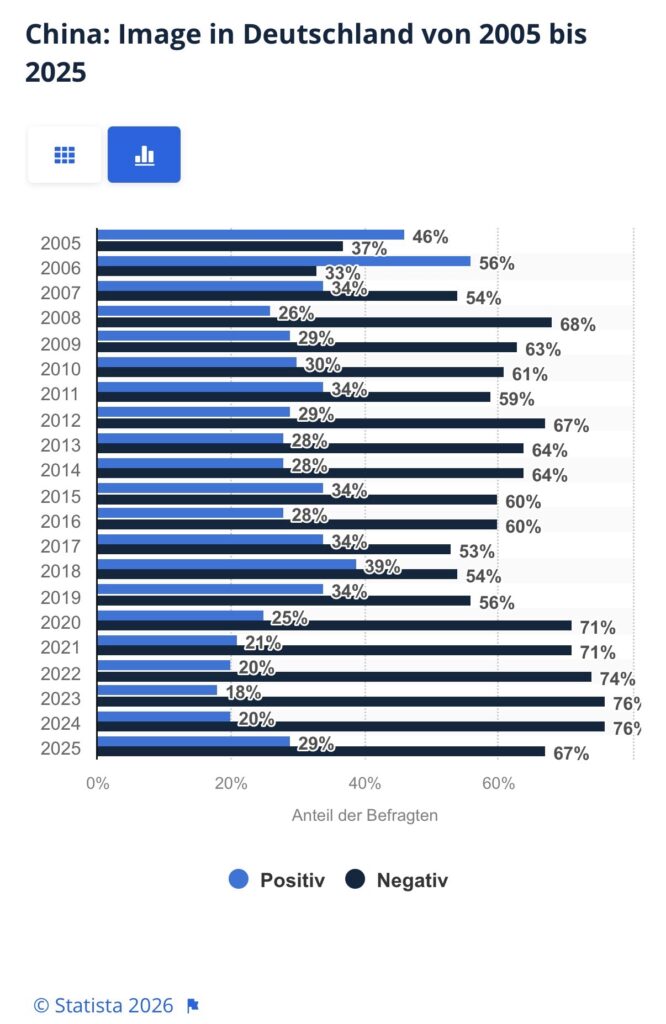
The image a society forms of another country influences far more than just public opinion. It determines whether young people want to study there, whether companies invest, and how politicians act on a diplomatic level.
A recent study by China Observers in Central Europe (CHOICE) analyzes which factors shape German perceptions of China.
Media and politics as opinion-makers
The study identifies several key factors that shape Germany's image of China.
At the forefront are media coverage and political narratives. In recent years, the tone in German leading media outlets toward Beijing has noticeably hardened – and economic dependencies played a central role in this.
In 2024, Germany exported goods worth over 100 billion euros to China. This interdependence creates tension between critical distance and pragmatic interest.
The personal factor: exchange and experience
An often underestimated aspect is direct encounter. People who have traveled to China or work with Chinese colleagues develop more nuanced views.
However, the number of German students in China has declined significantly since the pandemic. Similar trends can be seen in academic cooperation and city partnerships. Less personal contact means more room for abstract enemy images.
Lessons for Austria
The German findings are transferable to Austria. Here too, it is mainly media coverage and political debates that shape the image of China. Direct exchange remains limited.
For Austrian companies that are active in China or want to become active there, this has concrete consequences. A negative image makes it harder to secure political support for trade relations. The Austrian Federal Economic Chamber recorded around 1,200 companies with China business in 2024.
The analysis reveals a fundamental dilemma. A purely negative perception of China prevents objective discussions about necessary cooperation, for example on climate protection or global health issues.
An overly positive one, on the other hand, blanks out legitimate points of criticism. For both Germany and Austria, the same applies: a nuanced image of China does not emerge on its own.
It requires more direct exchange, independent research, and a media landscape that can bear complexity instead of simplifying it. The responsibility lies on both sides.
Source: chinaobservers | Original Article