Half a billion Chinese use AI apps – Europe’s lag grows
New market data show explosive growth in Chinese AI applications. The three leading apps together reach more users than the EU has inhabitants. Photo: BigGo Finance
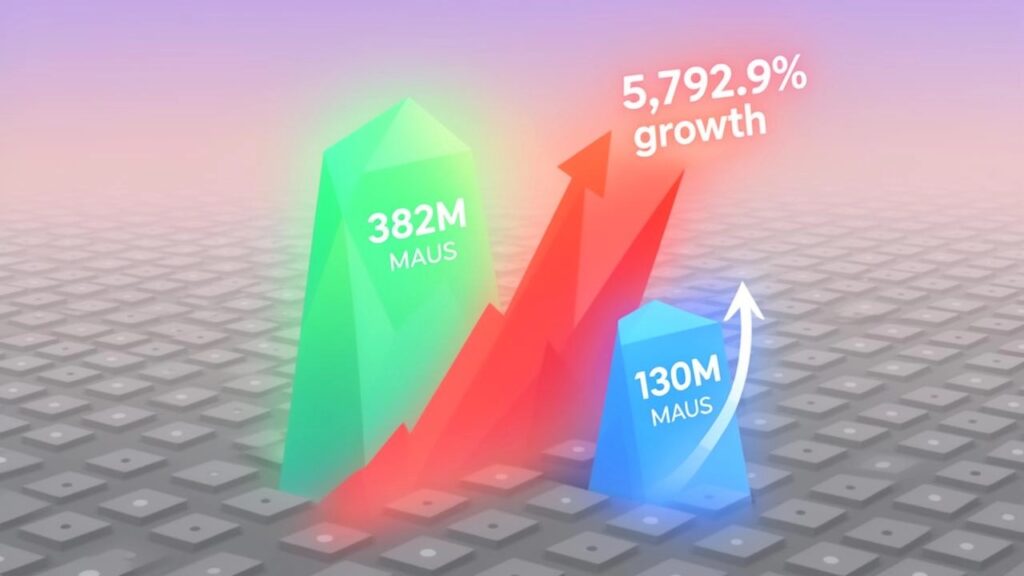
China's AI sector records user growth that even exceeds optimistic forecasts. According to the current half-year report of market research firm QuestMobile, so-called AI-native apps in May 2026 reached a total of 499 million monthly active users. This corresponds to an increase of 85.4 percent compared to the previous year.

Three providers dominate the market
The top position is held by Doubao, an AI application of the ByteDance group, with 382 million monthly active users. In second place follows Qwen from Alibaba with 167 million users, while DeepSeek, a startup that caused a stir in early 2025 with its efficient open-source model, records 130 million users.
The three leading Chinese AI apps together reach more people than the entire European Union's population.
QuestMobile deliberately distinguishes in its survey between AI-native applications and conventional apps that merely integrate AI functions. This differentiation underscores that they are standalone products whose core function is based on generative artificial intelligence, comparable to ChatGPT in the USA or the Austrian startup Nyonic.
Technological self-reliance as a state goal
The rapid growth is no accident. Beijing has declared the development of domestic AI technologies a strategic priority, not least as a response to US export restrictions on high‑performance chips. Chinese companies are increasingly focusing on efficiency optimization and their own semiconductor development. DeepSeek already demonstrated in January 2025 that powerful language models can be trained with less advanced hardware.
User numbers also reflect a cultural willingness to integrate new technologies quickly into everyday life. While in Europe data‑privacy concerns and regulatory hurdles, such as the EU AI Act, slow adoption, China is experiencing widespread adoption across the country.
What does that mean for Austria?
For Austrian companies, this development presents both opportunities and risks.
The domestic export economy is heavily oriented toward the Chinese market; in 2025 goods worth about €5.8 billion were shipped to China. At the same time, technological competition is intensifying. European AI applications such as the French Mistral or Germany's Aleph Alpha operate with user numbers in the single‑digit‑million range.
For Austria's research landscape, the dynamics in Asia increase pressure. The Austrian Institute of Technology and university research groups are working on AI applications for industry and medicine, but without sufficient scaling Europe risks falling behind in the global AI race.
QuestMobile's figures illustrate a shift in technological weight: 499 million Chinese AI users face a fragmented European landscape, where even ChatGPT reaches only an estimated 100 million monthly users worldwide.
Source: TechNode | Original Article